![]()
From its earliest days, the United States saw itself as a nation with intense purpose. Not a static country, not a museum of inherited customs, but a project. Alexander Hamilton envisioned a commercial republic that would rival the great powers of Europe. The doctrine of manifest destiny pushed that ambition across a continent. After World War II, the same impulse extended outward into global leadership.
America, in other words, has always kept its eyes on the horizon.
But once the frontier had been settled, the U.S. seemed to turn inward, focusing its boundless energy and notion of destiny toward a social crusade. The progressive civil rights movement became the story Americans told about themselves more than any other. A nation built on outward expansion turned inward. The energy that once drove settlers westward and engineers skyward was redirected into a different kind of project: a moral and social crusade at home.
This narrative is so powerful that it now dominates both the conservative and liberal mind. This means that the U.S. no longer really has a conservative movement, but rather two competing versions of the same progressive teleology that only disagree about the pace at which the social revolution should be pursued.
Restless people settled the US; we barely complete the conquest of one challenge before some group splinters off to brave the next frontier.
The philosopher Aristotle is famous for his discussion of telos — the end or purpose of a thing. Many modern thinkers have discarded this notion of ultimate purpose in favor of a more materialistic understanding of the world, but Aristotle is right, and they are wrong. America was always a nation in tension, recognizing the need to solidify its identity as the first true product of the New World even as it was immediately compelled forward by ambition. Restless people settled the U.S.; we barely complete the conquest of one challenge before some group splinters off to brave the next frontier. The American advance has always been relentless. Our nation is one of great purpose and great energy that will be directed toward whatever end we put our minds to.
For most of its history, America’s telos was expansion. Not merely territorial, but civilizational. A restless people moved outward, solved one problem, then immediately sought the next. This produced enormous dynamism. It also produced tension. The country had to define itself even as it constantly outgrew its previous definitions.
The civil rights myth
North America is the natural domain of the United States, but once the West had been truly settled, there was nowhere left for that pioneering spirit to expand. World War II proved to be the nation’s most radical period of transformation, during which it emerged as one of only two real superpowers dominating the globe. There were attempts to redirect that impulse. The space race briefly reopened the horizon. The competition with the Soviet Union offered a global stage. But these proved temporary. The deeper shift was happening at home.
The civil rights movement had begun as a reasonable request for legal equality, but was quickly merging with hippie culture and anti-Vietnam protests into a full-blown revolutionary deconstruction of America. The story of the civil rights movement was no longer the effort to seek a temporary solution for a wrong done to a specific group. Instead the movement fully embraced the progressive and Marxist themes of its contemporaries. America was no longer a great nation that needed to make some adjustments to integrate black citizens better; it was an eternal oppressor that had to be entirely reconstructed.
That shift matters because it supplied a new telos. If the old purpose had been expansion, the new one was equality, understood not as a condition to be achieved, but as a process without end. Every disparity became evidence of unfinished work. Every institution became suspect. The project could not conclude because its logic required constant renewal.
Conservatives initially stood against the civil rights revolution. Barry Goldwater famously opposed the Civil Rights Act of 1964, not because he supported Jim Crow, but because he understood the legislation as a revolutionary attack on states’ rights. Many conservatives initially objected to Ronald Reagan enshrining the Martin Luther King Jr. holiday into law because they still remembered that King was a communist sympathizer and serial adulterer who supported what we would later call DEI.
It was very clear that the CRA had already mutated well beyond its initial purpose and that civil rights law was expanding to consume every area of American life. But every movie, television show, novel, and news broadcast was selling the civil rights revolution as the new story of America. Conservatives never stood a chance.
The new telos of America was one of equality. The framers had written that “all men were created equal,” and it was now the purpose of the U.S. to make that a reality. While Thomas Jefferson may have penned those famous words, it is very clear that neither he nor most of the founding generation meant them in the way modern Americans do today. The continuation of slavery is the obvious example, but early American immigration laws restricted naturalization to whites of good character.
Alexis de Tocqueville, author of "Democracy in America," famously argued that American blacks and Anglos were incompatible and that a race war would likely come before any national civil war. Even Abraham Lincoln was not optimistic about the integration of black and white America, with plans to send former slaves back to Africa once the Civil War was concluded. Whatever previous generations meant by that famous phrase, they obviously did not believe in a never-ending quest to remake society in the name of equality.
Predictably, leftists took the revolution as far and as fast as they could. America’s original sin was slavery, and the country’s entire purpose was now a never-ending mission to atone for this great evil. The suppression of black Americans was systemic, so the United States had to deconstruct all previous hierarchies to avoid oppression. First race, then gender roles, then marriage, then religion, then the concept of biological sex itself. No matter how absurd the exercise proved itself to be, the hunt for one new oppressed minority to grant civil rights to became the telos of America.
Conservatives are the Washington Generals
Conservatives assumed their classic position as beautiful losers. They rejected the speed and intensity of the revolution but accepted the premise. Republicans went from rejecting MLK Day to worshiping the communist as some moderate paragon of the civil rights revolution. The conservative movement rapidly came to believe much of what the left was already asserting, but wanted the revolutionaries to drive the speed limit. Yes, the founders were racist. Yes, they had failed in their promise. Yes, the story of America was its eternal reinvention to achieve social equality. But also, the military and baseball are good, and maybe we can keep some of the Christianity because that also seems important.
This created a strange phenomenon: two competing progressive teleologies, one extreme and one more moderate, came to dominate the American mind. The conservatives began to manifest this ideology in areas of life where they held power. American foreign policy became one of eternal liberation, where our country would conquer the world in the name of liberal democracy.
Despite theoretically opposing feminism or gay rights in the U.S., conservatives would also cite violations of these civil rights as reasons to invade and control other countries. American churches, even conservative ones, began to center their message on race relations, liberation of the oppressed, and care for illegal immigrants. A real right wing no longer existed in America; the new frontier was the eternal civil rights revolution, and the only question was how far and how fast it should go.
This dynamic has created something of an identity crisis for the American right. On one hand, conservatives want to limit the excesses of the left; on the other, they have bought entirely into the progressive premise. American conservatives do not really want to return to the intention of the racist, sexist, and homophobic beliefs of the founders. They like the progress, they approve of the revolution, and they are ashamed of their past.
This subversion of the American vision is unfortunate, but it does not have to remain permanent. Instead of wasting our blood and treasure trying to turn every authoritarian backwater into a flourishing Jeffersonian republic, we could once again turn our eyes to the stars. Instead of trying to stamp out every form of inequality in our society, we could embrace hierarchy and the pursuit of greatness.
Instead of being ashamed of our founders, conservatives could follow manifest destiny to Mars and beyond. That requires rejecting the idea that the nation’s highest purpose is to endlessly remake itself in pursuit of abstract equality. It means accepting that hierarchy, excellence, and difference are not pathologies to be erased, but features of any functioning civilization. Before we can pursue the frontier once more, we must believe that we are a people with a purpose, a nation that deserves not just to survive, but to thrive.
 The Department of Education announced Tuesday that it has entered agreements with the Department of Justice and the Department of Health and Human Services (HHS) to transfer more of its responsibilities to other agencies, prepping the Education Department to one day be shut down for good. On a press call, senior department officials confirmed that […]
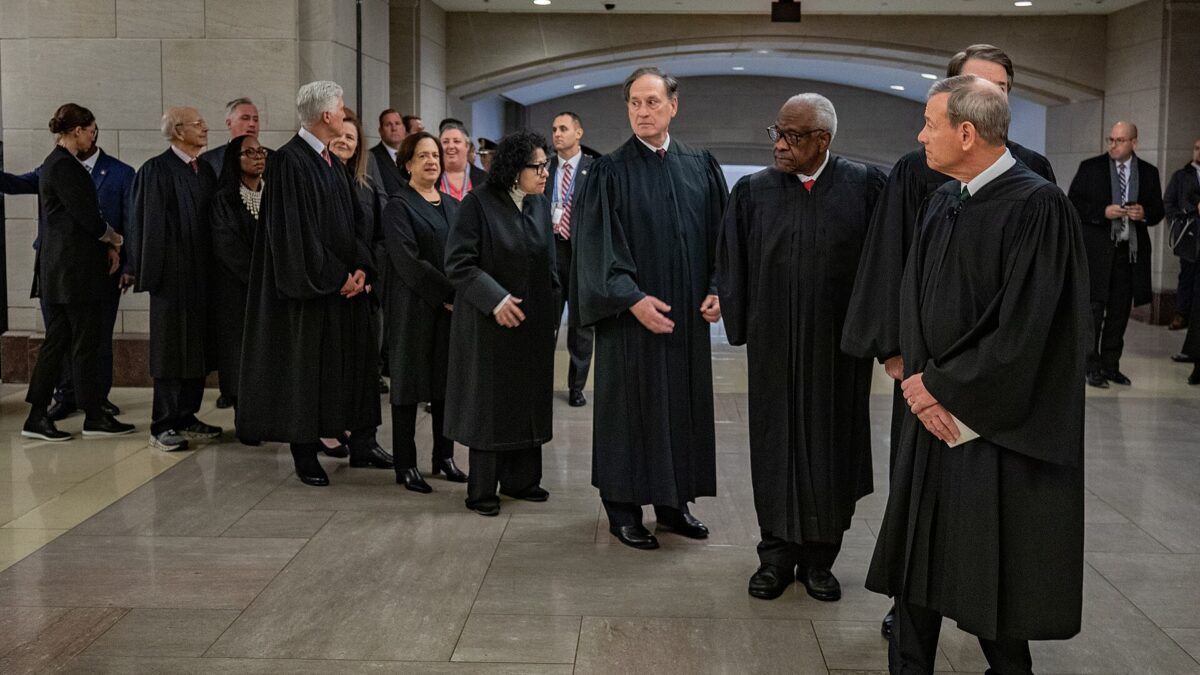 In his new article, Washington Post reporter Justin Jouvenal attempts to convince readers that SCOTUS has waged a war on 'civil rights.'
 Planned Parenthood of Illinois discriminated against white employees through illegal DEI training, the EEOC says.
 WILL alleges the states continue to employ state-based Minority Business Enterprise programs to achieve 'racial goals.'
 Photo by Stephen Maturen/Getty Images
 Democrats do not want the specious nature of their charge of racism to be revealed, let alone adjudicated.
 www.theblaze.com
 www.theblaze.com
 thefederalist.com
 www.theblaze.com