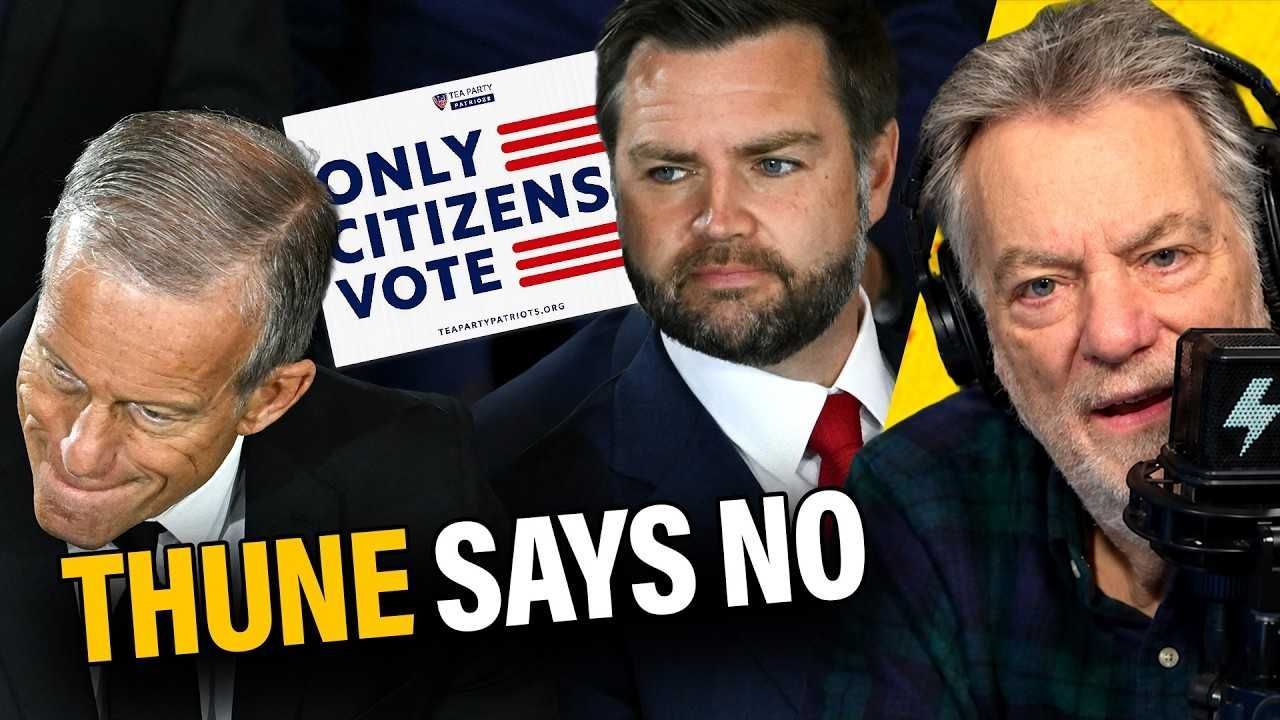
How Using Talking Filibuster For Trump’s SAVE Act May Be Minefield For GOP

'Much more complicated and risky than people are assuming at the moment'

Democrats Have Put Republicans In Win-Win Situation Just In Time For Midterms

They're in denial about the reality of their political situation

New York Democrat threatens to nuke filibuster and pack Supreme Court in order to grab guns


A Democratic lawmaker on the House Judiciary Committee casually threatened to blow up the Senate filibuster and pack the U.S. Supreme Court to confiscate guns during markup on a series of gun control proposals Thursday.

"Enough of your thoughts and prayers, enough," committee member Rep. Mondaire Jones (D-N.Y.) said, pounding the table during debate on the gun control package. "You will not stop us from advancing the Protecting Our Kids Act today. You will not stop us from passing it in the House next week. And you will not stop us there."

He continued: "If the filibuster obstructs us, we will abolish it. If the Supreme Court objects, we will expand it. And we will not rest until we have taken weapons of war out of circulation in our communities.

"Each and every day we will do whatever it takes to end gun violence. Whatever it takes," he vowed.

\u201cRep. Mondaire Jones (D-N.Y.) promises "whatever it takes to end gun violence." \n\n"If the filibuster obstructs us, we will abolish it. If the Supreme Court objects, we will expand it. And we will not rest until we have taken weapons of war out of circulation in our communities."\u201d
— Chris Pandolfo (@Chris Pandolfo) 1654185330

The Democratic-led committee is meeting in an emergency session Thursday to debate eight gun control bills collectively called the Protecting Our Kids Act. Moving the omnibus legislation out of committee and onto the House floor for a vote is a priority for Democrats, who want to score political points by putting Republicans on the record opposing gun control after the recent mass shootings in Buffalo, New York, and Uvalde, Texas.

Chairman Jerry Nadler (D-N.Y.) said that the American people are "begging for us to address" gun violence in remarks opening debate on the package.

"Let us not wait one second longer," he said, claiming that the legislation put forward by Democrats is "wildly popular" with the American public.

However, the proposals Democrats are pushing are almost certainly too extreme to become law. The House bills would raise the age requirement to buy a semi-automatic rifle from 18 to 21 years old; criminalize the import, sale, manufacture, transfer, or possession of high-capacity magazines; and put new regulations on bump stocks among other measures.

The Democratic Senate majority is not big enough to pass any of these bills without Republican support, and it is highly unlikely there are 10 Republican senators willing to help Democrats reach the 60-vote threshold to overcome a GOP-led filibuster.

But Jones is in a position to benefit from denying reality and threatening to burn down American institutions to get what Democrats want. He's running in a tough primary election for New York's newly drawn 10th Congressional District, where he will face former New York City Mayor Bill de Blasio in a contest to see who can show Lower Manhattan and Brooklyn voters who's more progressive.

Part of the benefit of being an incumbent congressman is having a national platform to toss red meat to your base, as Jones did Thursday.

Tim Scott exposes Dem hypocrisy on Senate filibuster after Biden uses executive order for police reform


Republican Sen. Tim Scott (S.C.) called out Senate Democrats on Wednesday, exposing their hypocrisy on the Senate filibuster.

Scott's public condemnation came after President Joe Biden signed an executive order on police reform and used the second anniversary of George Floyd's death to mark the occasion.

The order, among other things, establishes a national registry of police officer misconduct, bans the use of choke holds by federal law enforcement agencies, limits the use of no-knock warrants by federal law enforcement agencies, and mandates that all federal officers wear activated body cameras.

What did Scott say?

The South Carolina Republican noted in a statement that Democrats used the Senate filibuster to block his police reform bill in 2020, despite the legislation containing many of the same provisions in Biden's executive order.

"After the radical ‘defund the police’ movement helped create the current crime wave, President Biden is pursuing a partisan approach to many of the exact same policy solutions I proposed in the JUSTICE Act just two year ago," Scott began.

"The fact is Democrats used a filibuster they call racist to block my reforms that they’re now embracing," he added.

In fact, the JUSTICE Act would have required local police agencies to share databases of disciplinary records, incentivized agencies to ban the use of choke holds, incentivized the use of activated body cameras and penalized non-compliance, and required the Justice Department to develop new training standards on "alternatives to use of force, de-escalation tactics, and techniques for responding to a behavioral health crisis," among other things.

Additionally, Scott chastised Biden for creating new roadblocks to safe and effective policing, which ultimately manifest as "divisive politics."

"While my proposal added funding to help local law enforcement comply with higher standards, the Democrats' proposal sets departments up for failure by issuing unfunded federal mandates," Scott said. "Making it harder for police to do their jobs to the best of their ability should be a nonstarter, yet that’s exactly what the Biden plan does.

"I’m disappointed that the president who campaigned on unity has once again fallen into the trap of divisive politics," he added.

Why did Democrats filibuster?

Senate Democrats blocked Scott's bill, which had bipartisan support, because they did not believe it went far enough to address problems with law enforcement practices.

In contrast with Scott's bill that focused on incentivizing police reform, Democrats drew up their own bill that used government mandates to achieve the same results. Ultimately, neither bill became law.